
04 Aug 2026

Indore
- Indore
- Agra
- Ahmedabad
- Ahmednagar
- Ajmer
- Akola
- Aligarh
- Alwar
- Amravati
- Arrah
- Aurangabad
- Ayodhya
- Ballia
- Bareilly
- Barmer
- Basti
- Beed
- Begusarai
- Bengaluru
- Betul
- Bhagalpur
- Bharatpur
- Bhilwara
- Bhopal
- Bikaner
- Bilaspur
- Burhanpur
- Buxar
- Chamba
- Chandigarh
- Chennai
- Chhapra
- Chhindwara
- Chittorgarh
- Coimbatore
- Darbhanga
- Delhi
- Dewas
- Dhenkanal
- Dhule
- Dungarpur
- Etawah
- Faridabad
- Firozabad
- Gandhinagar
- Gaya
- Ghaziabad
- Gorakhpur
- Gurugram
- Gwalior
- Hamirpur
- Harda
- Hoshangabad
- Hyderabad
- Indore
- Jabalpur
- Jaipur
- Jaisalmer
- Jalgaon
- Jhansi
- Jodhpur
- Kangra
- Kanpur
- Katihar
- Katni
- Khandwa
- Khatima
- Kinnaur
- Kolhapur
- Kolkata
- Kota
- Kullu
- Lahaul and Spiti
- Latur
- Lucknow
- Mandi
- Mathura
- Meerut
- Moradabad
- Motihari
- Mumbai
- Munger
- Muzaffarpur
- Nagaur
- Nagpur
- Nanded
- Nashik
- Neemuch
- Noida
- Pali
- Parbhani
- Patna
- Prayagraj
- Pune
- Pune Maharashtra
- Purnia
- Ratlam
- Rewa
- Rohtak
- Sagar
- Saharanpur
- Samastipur
- Sangli
- Sasaram
- Satara
- Satna
- Seoni
- Shimla
- Shivpuri
- Sikar
- Sirmaur
- Sitamarhi
- Siwan
- Solan
- Solapur
- Sonipat
- Surat
- Tonk
- Udaipur
- Ujjain
- Una
- Vadodara
- Varanasi
- Vidisha
- Wardha
- Yavatmal
Indore
- Indore
- Agra
- Ahmedabad
- Ahmednagar
- Ajmer
- Akola
- Aligarh
- Alwar
- Amravati
- Arrah
- Aurangabad
- Ayodhya
- Ballia
- Bareilly
- Barmer
- Basti
- Beed
- Begusarai
- Bengaluru
- Betul
- Bhagalpur
- Bharatpur
- Bhilwara
- Bhopal
- Bikaner
- Bilaspur
- Burhanpur
- Buxar
- Chamba
- Chandigarh
- Chennai
- Chhapra
- Chhindwara
- Chittorgarh
- Coimbatore
- Darbhanga
- Delhi
- Dewas
- Dhenkanal
- Dhule
- Dungarpur
- Etawah
- Faridabad
- Firozabad
- Gandhinagar
- Gaya
- Ghaziabad
- Gorakhpur
- Gurugram
- Gwalior
- Hamirpur
- Harda
- Hoshangabad
- Hyderabad
- Indore
- Jabalpur
- Jaipur
- Jaisalmer
- Jalgaon
- Jhansi
- Jodhpur
- Kangra
- Kanpur
- Katihar
- Katni
- Khandwa
- Khatima
- Kinnaur
- Kolhapur
- Kolkata
- Kota
- Kullu
- Lahaul and Spiti
- Latur
- Lucknow
- Mandi
- Mathura
- Meerut
- Moradabad
- Motihari
- Mumbai
- Munger
- Muzaffarpur
- Nagaur
- Nagpur
- Nanded
- Nashik
- Neemuch
- Noida
- Pali
- Parbhani
- Patna
- Prayagraj
- Pune
- Pune Maharashtra
- Purnia
- Ratlam
- Rewa
- Rohtak
- Sagar
- Saharanpur
- Samastipur
- Sangli
- Sasaram
- Satara
- Satna
- Seoni
- Shimla
- Shivpuri
- Sikar
- Sirmaur
- Sitamarhi
- Siwan
- Solan
- Solapur
- Sonipat
- Surat
- Tonk
- Udaipur
- Ujjain
- Una
- Vadodara
- Varanasi
- Vidisha
- Wardha
- Yavatmal
- By Admin
- 0 Comments
- 17 Jul 2026
How to Rank Your Business on Google | Complete SEO Guide for Indian Businesses
-
Increase online visibility
-
Generate qualified business enquiries
-
Build customer confidence
-
Reach new markets
-
Strengthen brand recognition
-
Reduce dependence on paid advertising
-
Create sustainable long-term growth
-
Relevance
-
Content quality
-
Website experience
-
Authority
-
Page speed
-
Mobile usability
-
User satisfaction
-
Better website structure
-
High-quality content
-
Faster loading pages
-
Mobile-friendly design
-
Clear navigation
-
Useful information
-
Technical optimization
-
Industrial Equipment Manufacturer
-
Textile Supplier
-
Chemical Exporter
-
Business Consultant
-
Loan Services
-
Packaging Company
-
Digital Marketing Agency
-
Manufacturer
-
Supplier
-
Insurance
-
Finance
-
Plastic Packaging Manufacturer in Gujarat
-
Loan Consultant for Small Businesses
-
Industrial Valve Supplier in Pune
-
Clear page titles
-
Informative meta descriptions
-
Proper heading structure
-
Helpful content
-
Internal organization
-
Image optimization
-
Readable formatting
-
Secure HTTPS connection
-
Fast loading speed
-
Mobile responsiveness
-
XML Sitemap
-
Robots.txt configuration
-
Clean URL structure
-
Structured navigation
-
Publishing duplicate content
-
Ignoring page speed
-
Poor mobile experience
-
Missing page titles
-
Weak meta descriptions
-
Broken links
-
Keyword stuffing
-
Thin content with little value
-
Inconsistent website structure
-
Outdated information
-
Building high-quality backlinks
-
Brand mentions
-
Business directory listings
-
Industry citations
-
Guest articles
-
Digital PR
-
Social media presence
-
Industry websites
-
Business associations
-
News publications
-
Educational institutions
-
Government resources
-
Professional business directories
-
Buying guides
-
Industry insights
-
Product comparisons
-
Market trends
-
Business tips
-
Educational articles
-
Frequently asked questions
-
Experience
-
Expertise
-
Authoritativeness
-
Trustworthiness
-
Publishing accurate information
-
Updating content regularly
-
Showcasing industry knowledge
-
Being transparent about products and services
-
Providing clear contact details
-
Maintaining a professional website
-
Organization
-
Local Business
-
Product
-
Article
-
FAQ
-
Breadcrumb
-
Review
-
Fast loading pages
-
Stable page layout
-
Quick interaction time
-
Mobile responsiveness
-
Secure browsing
-
Adapt to different screen sizes
-
Display readable text
-
Offer simple navigation
-
Provide clickable buttons
-
Load efficiently on mobile networks
-
Accurate
-
Well-structured
-
Easy to understand
-
Comprehensive
-
Updated regularly
-
Organic traffic
-
Keyword rankings
-
Website impressions
-
Click-through rate (CTR)
-
Average engagement time
-
Bounce rate
-
Indexed pages
-
Customer enquiries
-
Publishing duplicate content
-
Ignoring user search intent
-
Using misleading page titles
-
Writing weak meta descriptions
-
Neglecting mobile optimization
-
Slow website speed
-
Broken internal links
-
Poor navigation
-
Outdated information
-
Overusing keywords unnaturally
-
Publish original, high-quality content.
-
Keep business information accurate.
-
Optimize page titles and meta descriptions.
-
Improve website speed.
-
Ensure mobile responsiveness.
-
Use clear heading structures.
-
Create helpful articles regularly.
-
Build quality backlinks naturally.
-
Monitor website performance.
-
Update older pages with fresh information.
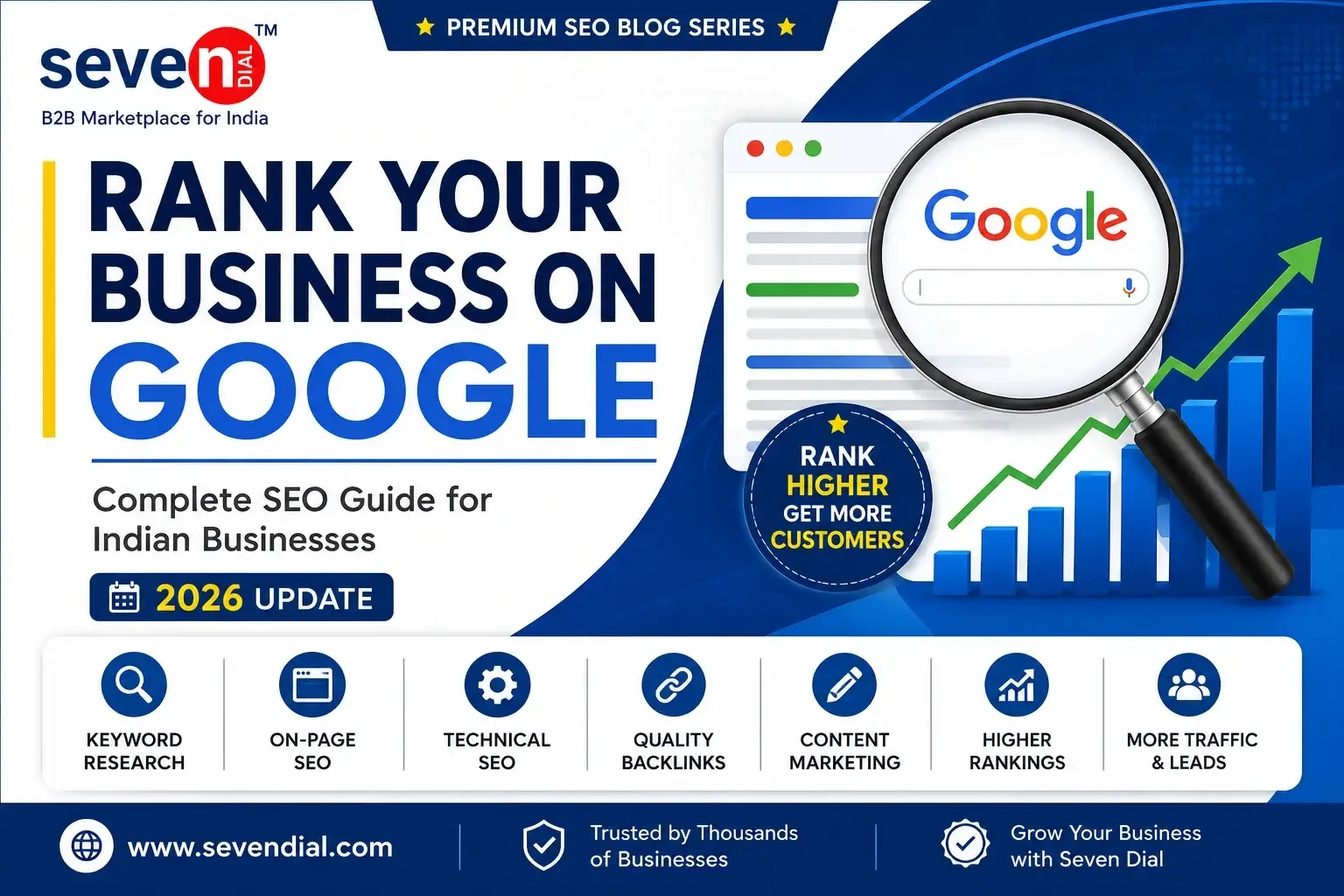
How to Rank Your Business on Google in 2026: The Complete SEO Guide for Indian Businesses
Introduction
Every day, millions of people search Google to find products, services, manufacturers, suppliers, consultants, contractors, and local businesses. Whether someone wants a machine supplier in Ahmedabad, a packaging company in Delhi, or a finance consultant in Agra, their journey usually begins with a search engine.
Now imagine two businesses offering almost the same products and services. One appears on the first page of Google, while the other is buried several pages behind.
Which business is more likely to receive enquiries?
The answer is obvious.
Most users rarely go beyond the first page of search results. Businesses that rank higher naturally receive more visibility, more website visitors, and more opportunities to generate enquiries.
This is why Google ranking has become one of the most valuable assets for any business.
The good news is that ranking on Google is not based only on company size or advertising budget. Search engines reward businesses that provide useful information, maintain quality websites, and create a better experience for users.
This guide explains how Google ranks websites, what Search Engine Optimization (SEO) really means, and how businesses can build a strong foundation for long-term organic growth.
Why Google Ranking Matters
Google is more than a search engine—it is one of the primary ways customers discover businesses.
When your website ranks higher, you increase the chances of being seen by people who are already searching for your products or services.
A strong Google presence helps businesses:
Higher rankings do not guarantee instant success, but they significantly improve the opportunity to connect with potential customers.
How Google Search Works
Many people think Google simply stores websites and displays them randomly.
In reality, Google uses sophisticated systems to organize and evaluate billions of web pages before deciding which ones appear for a search.
The process can be understood in three major stages.
1. Crawling
Google continuously discovers new pages by following links across the internet.
This process is called crawling.
Search engine bots visit websites, read their content, and identify new or updated pages.
If a website is difficult to access or poorly structured, search engines may not discover all of its content.
2. Indexing
Once Google discovers a page, it analyzes the information and stores it in its search index.
The search index acts like a massive digital library.
Only pages that are properly indexed can appear in Google Search results.
3. Ranking
When someone performs a search, Google compares millions of indexed pages and determines which ones best answer the user's query.
Ranking depends on many factors, including:
Google's goal is to show the most helpful and trustworthy results first.
What Is SEO?
SEO, or Search Engine Optimization, is the process of improving a website so that it becomes easier for search engines to understand and easier for users to navigate.
Good SEO focuses on providing value rather than trying to manipulate rankings.
SEO includes improvements such as:
Effective SEO helps search engines understand your business while creating a better experience for visitors.
Organic Results vs Paid Results
Businesses often confuse SEO with advertising.
Although both help increase visibility, they work differently.
Organic Search Results
Organic rankings are earned through quality content, optimization, and relevance.
These results are not advertisements.
Businesses invest time in improving their websites instead of paying for every click.
Paid Search Results
Paid advertisements appear because businesses bid on keywords.
Traffic usually stops once advertising campaigns end.
SEO focuses on building long-term visibility, while paid advertising provides immediate exposure.
Many successful businesses use both approaches together.
Understanding Search Intent
One of the biggest SEO mistakes is focusing only on keywords instead of understanding what users actually want.
Search intent refers to the reason behind a search.
Different searches have different goals.
For example:
Someone searching "What is Local SEO?" wants information.
Someone searching "Best packaging manufacturer in India" is comparing businesses.
Someone searching "Contact steel supplier in Mumbai" is likely ready to make an enquiry.
Businesses that create content matching user intent have a better chance of ranking well.
Keyword Research: The Foundation of SEO
Keywords are the words and phrases people type into search engines.
Understanding how customers search helps businesses create content that answers real questions.
Examples include:
Instead of targeting only broad keywords, businesses should also focus on specific search phrases that closely match customer needs.
Types of Keywords
A successful SEO strategy usually includes different keyword categories.
Short-Tail Keywords
These are broad search terms.
Examples:
They usually have high competition.
Long-Tail Keywords
These are more specific search phrases.
Examples:
Long-tail keywords often attract more targeted visitors because they reflect a clearer search intention.
On-Page SEO Fundamentals
On-page SEO refers to the improvements made directly on website pages.
Important elements include:
Well-organized pages make it easier for both users and search engines to understand the content.
Technical SEO Basics
Technical SEO ensures that your website functions correctly behind the scenes.
Important areas include:
Technical optimization supports better crawling, indexing, and user experience.
Common SEO Mistakes
Many businesses unintentionally reduce their Google visibility.
Some common mistakes include:
Avoiding these mistakes helps create a stronger SEO foundation.
SEO Is a Long-Term Strategy
One of the biggest misconceptions about SEO is that results happen overnight.
Search engines evaluate websites over time.
Consistent improvement in content quality, website performance, and user experience gradually builds authority.
Businesses that focus on long-term value rather than quick shortcuts are more likely to achieve sustainable rankings.
Off-Page SEO: Build Your Website's Authority
Creating a great website is only one part of SEO. Google also evaluates how your business is recognized across the internet.
Off-Page SEO refers to activities that help establish your website's credibility and authority beyond your own pages.
A strong online reputation signals that your business is trusted by customers and other websites.
Important Off-Page SEO activities include:
The focus should always be on earning genuine recognition rather than trying to manipulate rankings.
Understanding Backlinks
A backlink is a link from another website pointing to your website.
Search engines often treat backlinks as signals of trust, but not all backlinks carry the same value.
High-quality backlinks generally come from:
A few relevant, high-quality backlinks are usually more valuable than hundreds of low-quality links.
Why Content Marketing Improves Google Rankings
Google rewards websites that consistently publish useful information.
Content marketing helps businesses answer customer questions, demonstrate expertise, and create additional opportunities to appear in search results.
Useful content may include:
Every helpful article becomes another opportunity for potential customers to discover your business.
The Importance of E-E-A-T
Google places significant emphasis on content that demonstrates:
Businesses can strengthen these qualities by:
Building trust takes time, but it is one of the strongest long-term ranking factors.
Schema Markup: Helping Search Engines Understand Your Website
Schema markup is structured data added to your website that helps search engines better understand your content.
Although users may not see it directly, schema provides additional context about your business and pages.
Common schema types include:
Proper implementation can improve how your pages appear in search results.
Core Web Vitals and User Experience
Google also evaluates how users experience your website.
Important performance indicators include:
A fast and user-friendly website encourages visitors to stay longer and explore more pages.
Mobile-First SEO
Most business searches now happen on smartphones.
Your website should:
A mobile-friendly website improves both user satisfaction and search performance.
AI Search and the Future of Google
Search technology continues to evolve with artificial intelligence.
Modern search experiences increasingly focus on providing direct, helpful answers while highlighting reliable sources.
Businesses should prepare by creating content that is:
The goal is no longer to write only for search engines but to create content that genuinely helps users.
Track Your SEO Performance
SEO should always be measured.
Regularly monitor important metrics such as:
Tracking performance helps identify what is working and where improvements are needed.
Common SEO Mistakes That Prevent Higher Rankings
Even well-designed websites can struggle if they overlook basic SEO practices.
Avoid these common mistakes:
SEO success comes from providing value—not from shortcuts.
Practical SEO Checklist
Use this checklist to strengthen your website over time:
Consistency is more important than making many changes at once.
Frequently Asked Questions (FAQ)
1. How long does it take to rank on Google?
SEO is a long-term strategy. Depending on competition, website quality, and consistency, noticeable improvements may take several months.
2. Is SEO better than paid advertising?
Both have advantages. Paid advertising delivers immediate visibility, while SEO builds sustainable organic traffic over time. Many businesses benefit from using both together.
3. Do backlinks still matter?
Yes. Relevant and trustworthy backlinks remain an important signal of authority, but quality is far more valuable than quantity.
4. Can small businesses rank on Google?
Absolutely. Businesses of any size can improve their rankings by creating valuable content, optimizing their websites, and focusing on user experience.
5. Why should I update old content?
Refreshing existing content keeps it accurate and relevant, improving its usefulness for visitors and increasing its potential to perform well in search results.
Final Thoughts
Ranking on Google is not about finding shortcuts or exploiting algorithms. It is about building a website that deserves to be discovered.
Businesses that consistently publish valuable content, maintain a technically sound website, understand customer needs, and improve user experience create a strong foundation for long-term organic growth.
SEO requires patience, but the rewards—greater visibility, qualified traffic, stronger brand recognition, and sustainable enquiries—make it one of the most worthwhile investments for any business.
Conclusion
Google's search results are designed to connect users with the most relevant, helpful, and trustworthy information available.
By focusing on high-quality content, technical optimization, strong website performance, and customer satisfaction, businesses can improve their chances of ranking higher and attracting the right audience.
Success in SEO is not achieved through a single tactic. It comes from consistently delivering value, earning trust, and adapting to changing search trends.
Businesses that invest in these principles today will be better positioned to compete and grow in the digital marketplace for years to come.
Continue Reading Blogs
Expand your knowledge with these related guides:


Leave A Comment
Your email address will not be published. Required fields are marked *